Most mid-market pipelines carry 15–35% structurally unverifiable value — invisible to native CRM reporting, inherited by every forecast, and compounding with each planning cycle. That exposure doesn't stay in the pipeline. It moves into hiring plans, territory design, and board commitments.
The Diagnostic isolates that exposure, quantifies it in dollars, and delivers a version-stamped governance record within 48–72 hours.
No data stored. Processed in memory and immediately discarded.
Already have your score?
Payments secured by Stripe. You'll upload your CSV after checkout.
Internal pipeline reviews assess what your team enters. They do not measure what was never entered, what decayed after entry, or what the gaps between fields imply about forecast reliability.
Before Measurement
"Pipeline is $18.2M with 3.2x coverage."
"We did a cleanup last quarter."
"Forecast confidence is high."
"No structural verification conducted."
After Measurement
$5.4M structurally unverifiable (29.7%)
3 of 5 domains showing active drift
Classification: Material (CEI 52)
Verified pipeline: $12.8M of $18.2M
The pipeline number didn't change. The deals didn't move. What changed was what leadership knew before their next planning commitment.
Representative mid-market B2B pipeline · HubSpot · 6 AEs, 2 SDRs · Illustrative, not a client engagement
Deterministic detection across five weighted domains. No AI inference. No analyst judgment. Same data, same version, same score.
Missing fields, orphaned records, and consistency failures that undermine trust in pipeline metrics. Every missing close date is a deal the forecast counts but cannot schedule.
Stage velocity, deal progression quality, and leakage patterns that distort conversion assumptions. A deal in Commit for 60 days with no activity is still counted in this quarter's number.
Dormant records, engagement decay, and gaps between what stages claim and what activity data shows. When 40% of mid-stage deals have no recent activity, the coverage ratio is a fiction.
Lead sink patterns, routing failures, and qualification standards that have quietly loosened. Leads that never route never convert — but they still count as pipeline input.
Misalignment between reported metrics and underlying data. Forecast volatility traceable to structural causes. The board sees coverage ratios built on deals that were never structurally closable.
Not a score alone — specific dollar estimates per finding, per domain. Where the money is at risk and how much.
Missing governance controls identified and documented. Hand it directly to your RevOps lead or CRM partner as an execution spec.
Branded PDF with classification rationale, severity ranking, and recovery priorities. Reproducible. Auditable.
How It Works
Free Score
Upload your CSV. Receive CEI + tier classification.
Order
Data meets issuance thresholds. Proceed via Stripe.
Analysis
Deterministic scoring. 48–72 hours.
Delivery
Version-stamped PDF. You execute on your timeline.
Fixed-scope. One-time. Delivered within 48–72 hours.
| Feature | Diagnostic — $597 | Complete Package — $1,197 |
|---|---|---|
| Structural exposure analysis (5 domains) | Included | Included |
| Dollar-quantified findings | Included | Included |
| CEI score + tier classification | Included | Included |
| Control gap inventory | Included | Included |
| Version-stamped PDF report | Included | Included |
| 90-Day Recovery Architecture | — | Included |
| Control sequencing + ownership mapping | — | Included |
| Structural KPI suggestions | — | Included |
| Written clarification exchange | Included | Included |
Already have your score? Order directly.
Payments secured by Stripe. 48–72 hour delivery after data receipt.
Diagnostics run under the current framework version (RRF v1.3). Version updates are not retroactive.
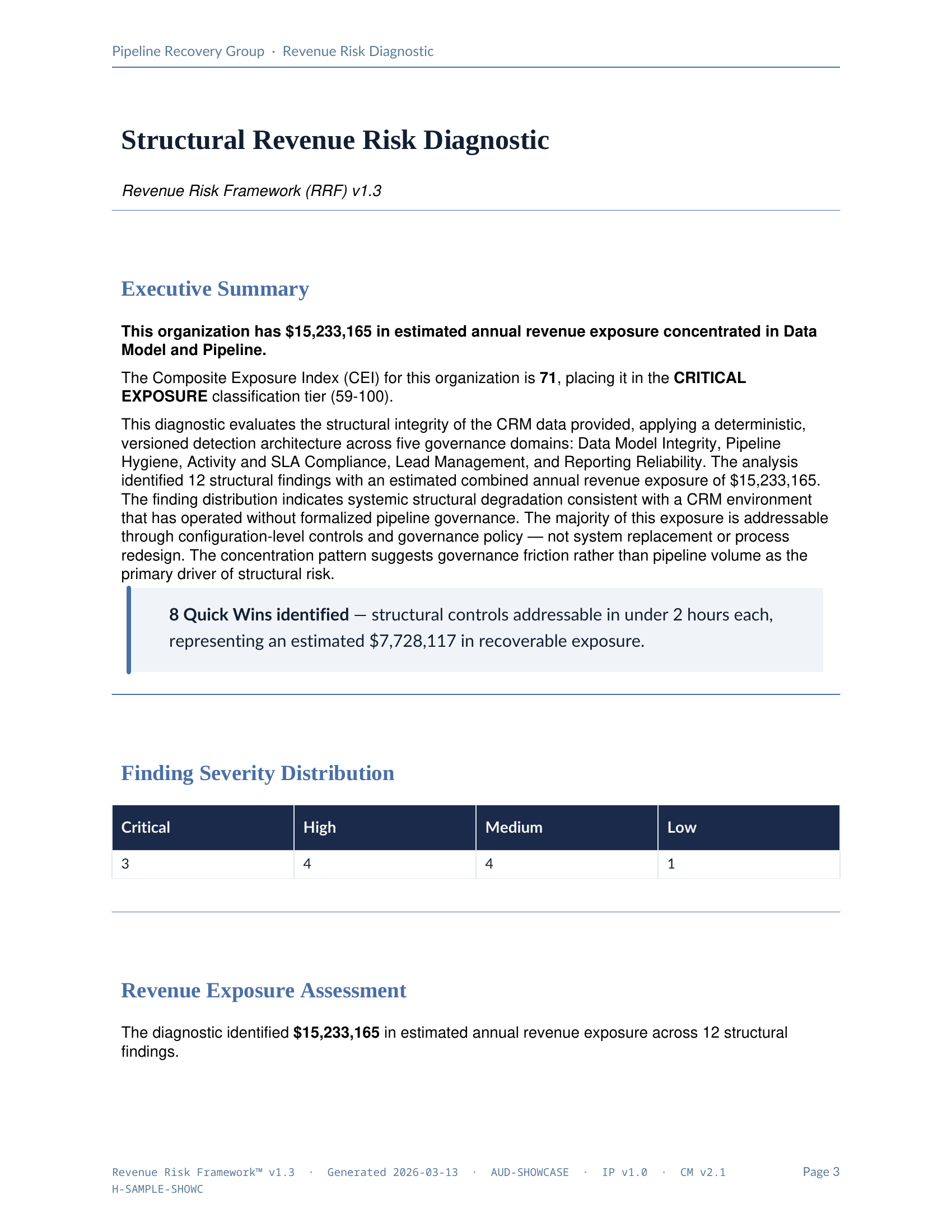
Full sample report — same format delivered to every client. 18 pages.
What's Inside
Executive Summary — CEI, tier, domain breakdown
Finding-by-finding analysis with dollar estimates
Control gap inventory + recovery priorities
No email required. Immediate download.
These are reasonable positions. They are also structurally untested.
Native CRM reporting measures what your team enters. It does not measure what was never entered, what decayed after entry, or what the gaps between fields imply about forecast reliability. Reporting reflects activity. Structural analysis measures the integrity of what reporting depends on.
Most pipelines that carry structural exposure still produce revenue. The question is whether the forecast variance between what's reported and what's structurally verifiable is within the tolerance your planning decisions assume. "It works" and "it's structurally sound" are different claims.
If the structural condition of your pipeline has never been independently measured, no existing report contains this information. A diagnostic is not a second opinion on data you already have. It's a first measurement of exposure that current reporting does not surface.
If the diagnostic produces a valid issuance and surfaces no governance-relevant findings, we refund the full amount. If the delivered report contains a verifiable discrepancy, we correct and reissue at no additional cost within 30 days.
Every submission is logged with a unique audit token and dataset fingerprint under the framework version in effect at issuance.
PRG operates under a strict independence framework. See Measurement Governance.
No data stored. Processed in memory and immediately discarded. Under two minutes.
Already have your score?
Payments secured by Stripe.